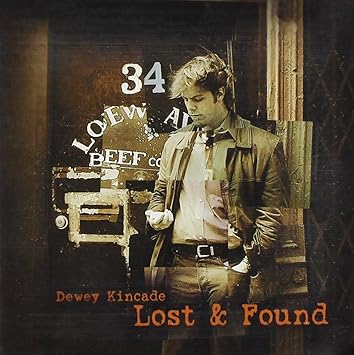
Twenty years ago I recorded Lost and Found. It was a strange time for me to say the least. About a year earlier I had released my debut solo album Who are the Navigators? That album had drawn a lot of attention in Louisville. I managed to get regular airplay on WFPK, got reviewed in The Courier Journal, and managed to perform on several local TV stations. Things were looking bright. And then I got cancer. I was 26 years old.
The year that followed was tumultuous. I had so many highs and lows on a weekly basis that I found it very hard to to make up my mind about anything. The looming question over my debut album was whether it would be a solo project or a band project. The question was never really answered. I had a crush on a woman who lived in New York, and we exchanged letters, but it never culminated in anything. People in the industry said that Who Are the Navigators? was all over the place, which it was. It was as if one song-writer tried to write their own White Album. I was told that I needed to focus on a particular sound, and I didn't know what that would be. All the while, I was debating whether I should move back to New York or stay in Louisville. I moved back for a while, but ended up returning home.
I had two operations. In between the two operations, I played South by Southwest for the first time. The second operation involved the removal of some lymph nodes, and it wasn't clear yet if the cancer had spread. The recovery lasted weeks. I was hobbling around on a cane, and I took to calling myself "the gimp." I began writing new songs, and I wanted to record another album.
One day that Summer, I came home to Louisville from a week in Michigan. I had been writing songs since my operation, and I was eager to get started. Colin Brown and I recorded an album in a week. It was really good, but the people with the money weren't ready to hand over the reins to us to produce an album.
Bob Brockman was brought to Louisville to see what we could create. We recorded some great tunes. They had polish, but the process and the vibe wasn't there. The tracks that Colin and I had recorded had vibe out the wazoo, but no polish. Somewhere between the two poles lied the truth. The money people wanted Bob, and thought it would make the most sense for me to go to New York. Colin did not want another producer in his studio. After the year I had, I didn't really have the wherewithal for a pitched battle on the subject. The money dried up, and the project seemed dead.
That's when a distant relative (but close friend) Susan Hardy came to the rescue. She was willing to invest in a new album. Colin and I were very excited, but then the question became what would be on the album? Bob had something along the lines of each song is a room in the same house, and they should reflect one another. The problem was that I wrote folk songs, hard rock and pop at different times. Rather than plant my foot firmly in one field, I proposed that we record all three.
Colin and I had been playing in a band with Dave Humphries called, The Money Shots. We played hard jammy rock. Dave is the type of musician who can play just about anything, so I enlisted him to play bass on all of the albums. In about a week, Colin, Dave and I had recorded the basic tracks to about three albums. Jimmy McDowell was on the other side of the glass. It was Fall.
As is usually the case, the goal is always to put the "best" songs on the album. At that point I had already written maybe two hundred songs. I liked most of them. Much like Who are the Navigators? the album(s) began to take shape as another hodge-podge album. "With the Wind" was written when I was 14, and "Can't Afford to Lose a Friend" was written when I was 26. It hadn't yet occurred to me that I should group the songs based on the time period in which they were written. I kind of wonder what that album might have sounded like.
As is usually the case, the goal is always to put the "best" songs on the album. At that point I had already written maybe two hundred songs. I liked most of them. Much like Who are the Navigators? the album(s) began to take shape as another hodge-podge album. "With the Wind" was written when I was 14, and "Can't Afford to Lose a Friend" was written when I was 26. It hadn't yet occurred to me that I should group the songs based on the time period in which they were written. I kind of wonder what that album might have sounded like.
Susan paid for musicians like Meredith Noel and Steve Cooley to come and play on the recordings. She also let me stay in her attic room in her house in the Highlands. The main problem I had during this time is that I had too much time when I was not in the studio. I could have recorded 16 hours a day 7 days a week, but that wasn't an option. Colin needed down-time. I was restless and anxious. I got a part-time job at Heine Brothers coffee, which didn't last, because I wanted to work in the afternoons, and they kept scheduling me in the mornings. It's hard to open up a coffee shop at 6 in the morning after you've been in the studio until 2 am, so that didn't last long.
Meanwhile, my crush had fizzled out. I don't know what I was thinking. She was in New York, and I was in Louisville. It was a relationship based on fantasy. Still I felt very alone and isolated. I don't think I played out once the entire year I was working on Lost and Found. My bandmates from the first Navigators felt like I had abandoned them. On an emotional level, I felt like I was running on fumes.
By midwinter, the tracks were coming together. We concluded that the only way to finish all the albums was to focus on them one at a time. The acoustic album became the first album that we focused on. The original goal was that the entire album would be exclusively acoustic instruments to separate it sonically from the other two. But gradually some organ and electric guitar appeared, and it began to be clear that this was going to be the only album that would ever get finished. As a result some of the songs that were slated to be pop songs migrated to the acoustic album.
When I began to play the mixes for people, I was told that it needed a bit more polish, so I asked Howie Gano to try mixing some of the songs. Colin was not happy about that, and for a while all recording stopped. The process was in suspended animation for a while.
In the mean-time I had started dating a woman I met who worked Actors Theatre. We moved in together in Indiana during the Summer. At this point I don't even recall why, but there was no money to put out the album. I had been generously supported by Susan during this time, and we were waiting on some money to proceed.
Danny Flanigan was probably the only reason I played out at all that year, and he invited me and Butch Rice to the share the stage at Twice Told Coffeehouse. Stephen Brown was there, and he took an interest in my material. He offered to help put the album out, and he began to coordinate the design with Dennis Smiley. Dennis used some pictures that Andrew Dailinger had taken on one of my brief sojourns to New York City.
My girlfriend had an offer to go to New York City, and I was conflicted about leaving Louisville again. The album wasn't done, I didn't have a band in New York. Maybe I could make some noise in Louisville as I had after my first album. I definitely thought that this would be stronger. In the end, I followed my heart, which turned out not to be a smart business move. I released the album when I was in New York City with a pick-up band. I had scheduled a release party so that I could sell copies of the album. Ironically the entire shipment was momentarily lost in transit (and later found), but it meant a CD release party with no CD.
In hindsight, I think I could have made better choices during this whole process, but art ain't pretty. In the end, I continue to be happy about this album. I am still proud of these recordings, and I hope you can get as much enjoyment out of it as I have over the years.
Danny Flanigan was probably the only reason I played out at all that year, and he invited me and Butch Rice to the share the stage at Twice Told Coffeehouse. Stephen Brown was there, and he took an interest in my material. He offered to help put the album out, and he began to coordinate the design with Dennis Smiley. Dennis used some pictures that Andrew Dailinger had taken on one of my brief sojourns to New York City.
My girlfriend had an offer to go to New York City, and I was conflicted about leaving Louisville again. The album wasn't done, I didn't have a band in New York. Maybe I could make some noise in Louisville as I had after my first album. I definitely thought that this would be stronger. In the end, I followed my heart, which turned out not to be a smart business move. I released the album when I was in New York City with a pick-up band. I had scheduled a release party so that I could sell copies of the album. Ironically the entire shipment was momentarily lost in transit (and later found), but it meant a CD release party with no CD.
In hindsight, I think I could have made better choices during this whole process, but art ain't pretty. In the end, I continue to be happy about this album. I am still proud of these recordings, and I hope you can get as much enjoyment out of it as I have over the years.

